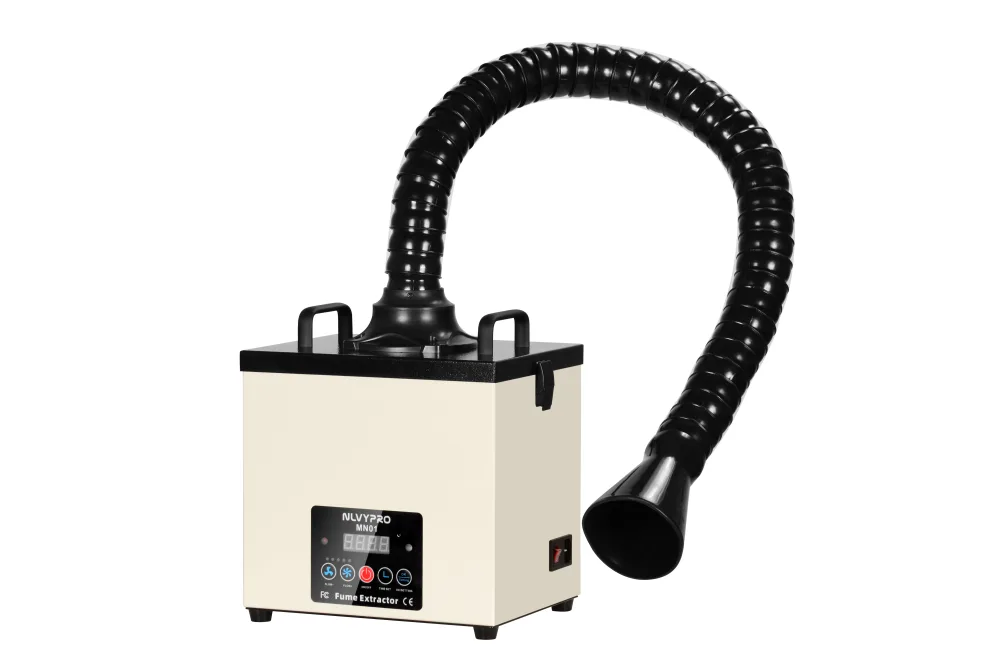
Choose a solder fume extractor by the capture setup, filter stages, maintenance access and operating conditions—not motor wattage alone. For an individual PCB or repair bench, start with a hood that can remain close to the soldering point, then confirm the airflow and filter configuration for the task.
1. Start with the soldering point
A desk fan moves air, while a source-capture system is arranged to draw fume into a hood and through a defined air path. The hood position, nearby drafts and working layout all affect capture. An extractor placed far from the solder joint may not perform as intended even if its listed airflow looks high.
Before choosing a unit, sketch the bench. Mark where the soldering iron, PCB holder, tools and operator will sit. Check whether the arm can reach the working point without blocking hand movement. Keep the hose route clear and avoid unnecessary sharp bends.
The UK Health and Safety Executive identifies source capture as a central part of local exhaust ventilation. Its guidance describes collecting contaminants close to where they arise. That is a setup principle, not certification of any particular desktop product. See HSE guidance on local exhaust ventilation.
2. Compare airflow without treating it as a guarantee
Motor power describes an electrical rating. Airflow describes a volume of air moved over time. Neither figure, by itself, tells you how well a particular hood captures a solder plume in your bench layout.
Ask whether a quoted airflow is measured with the hose and filters fitted, and under which operating conditions. Compare like-for-like figures where possible. Filter loading, hose length, bends and the selected setting can change actual performance.
NLVYPRO lists 105W and 155 CFM for MN01 and MN01W. These are manufacturer-stated specifications. They are useful for identifying the configuration, but they are not a guarantee of a capture distance or a particular workplace exposure level.
3. Look at the filter layers and replacement routine
MN01 and MN01W use the same compatible three-layer filter set: pre-filter cotton for larger particles, a HEPA stage for finer particles, and activated carbon for odor adsorption and certain gaseous contaminants. These layers have different jobs; a particle filter and a carbon layer are not interchangeable.
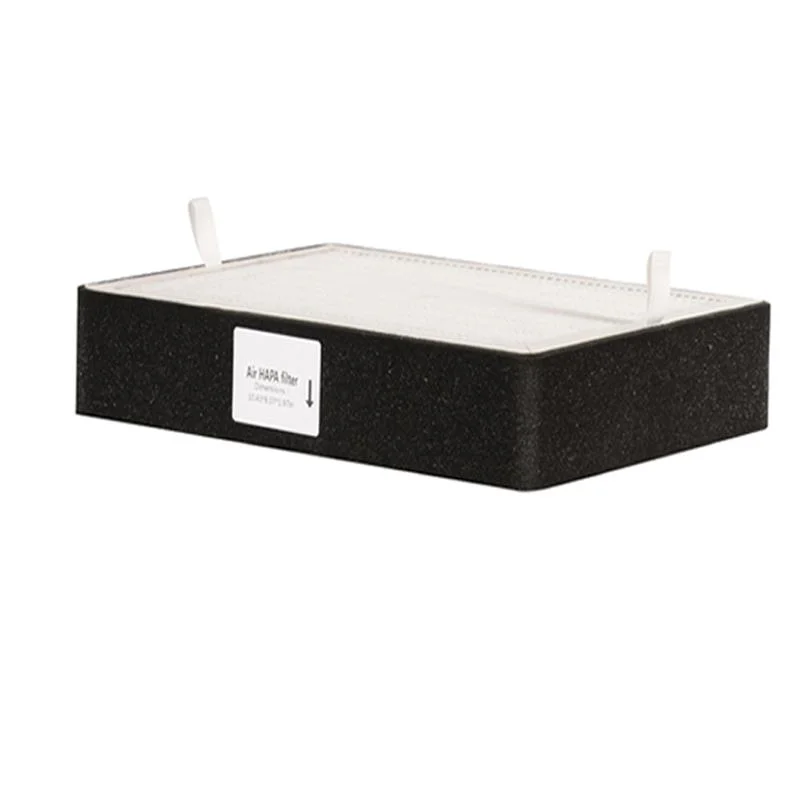
The manufacturer’s reference replacement intervals for MN01 are 7–15 days for pre-filter cotton, 4–8 months for HEPA and 8–12 months for activated carbon. Actual life depends on the environment and usage frequency. Treat these as planning estimates, then inspect the filter condition during use.
You do not need to replace every layer together. Start by checking the first-stage pad, then assess the remaining layers. Switch off and unplug before opening the machine. Follow the manual for the filter order and replacement procedure. Reduced odor alone does not show that every contaminant has been removed.
4. MN01 or MN01W: which configuration fits?
| Selection point | MN01 | MN01W |
|---|---|---|
| Core configuration | 105W, three-stage filtration | 105W, three-stage filtration |
| Listed airflow | 155 CFM | 155 CFM |
| Typical workstation tasks | Soldering, electronics repair, nail dust | The same tasks, plus selected small laser setups |
| Outdoor exhaust option | Choose by the documented MN01 configuration | Side connection and 2 m outdoor exhaust hose |
Choose the connection arrangement for your workspace. If you need to route residual odors outdoors, review MN01W specifications and confirm a suitable discharge route. For a compact individual bench setup, review the MN01 product page. Both offer panel and remote control with an S10–S100 display.
5. Common questions about solder fume extractors
Can I choose only by the highest CFM number?
No. Check the measurement conditions, hood position, hose route, filters and task. A higher advertised figure does not establish better capture in every installation.
Does a desktop extractor replace room ventilation?
Do not assume that it does. Consider source capture and room ventilation together, and assess the requirements of your process. HSE provides further background in its soldering guidance.
What should I send when requesting a recommendation?
Send the soldering process and material, daily operating hours, number of workstations, a bench photo, voltage requirement and any exhaust restrictions. These details help the manufacturer discuss a configuration that fits the actual task.
Explore soldering application models or read our laser fume extractor selection guide.